Brand
Get all logo versions.
Download 


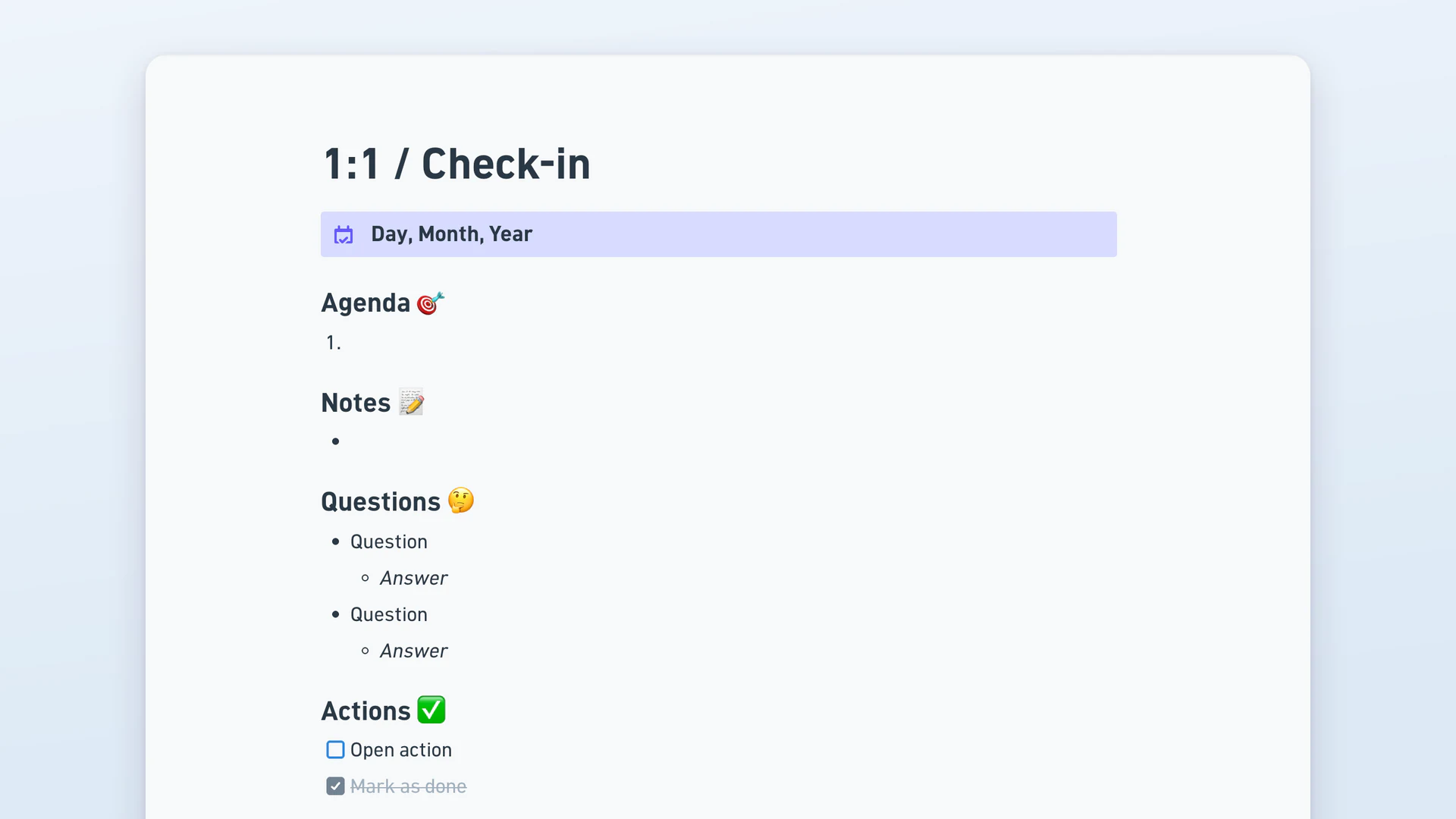
A one on one meeting is a recurring private conversation between a manager and someone who reports to them, usually weekly or fortnightly, covering current work, blockers, feedback and career. This template is a single screen: a dated header, an agenda, a notes area, a questions section where each question gets its own answer line, and an actions checklist. Duplicate it per meeting so the record builds over time.
A one on one is a recurring conversation, usually weekly, about current work, blockers and feedback, and nothing formal hangs on it. A performance review is periodic and formal: it produces a written assessment, a rating, and often decisions about pay or promotion. The two connect in one direction. Good one on ones mean the review contains nothing surprising, because everything in it has already been said out loud.
A one on one meeting is a regular private conversation between a manager and one of their direct reports, typically held weekly or every two weeks for 30 minutes. It covers current work, blockers, feedback in both directions, and longer-term career topics. Unlike a status update, the point is the conversation rather than the reporting, and the report's agenda matters as much as the manager's.
Four cover most sessions. What's blocking you that I could remove? What's the least useful part of your week right now? Is there anything you were hoping I'd ask about? And what feedback do you have for me? The last one is the hardest to ask well and the most useful, because it only produces honest answers once you've acted on the first few.
Ask about scope and expectations rather than reassurance. Good one on one meeting questions to ask manager side: what does good look like for me next quarter? Which of my work has been most useful to you? Is there anything you're hearing about my work that I'm not? Keep a standing one about what's changing that you don't know yet.
Weekly is the common default for direct reports, with fortnightly working once a relationship is established and the person is senior. Monthly tends to be too infrequent: the agenda fills with status updates because too much has happened to discuss anything properly. A weekly one on one meeting template makes the shorter cadence sustainable, since each doc only needs a few lines.
The manager schedules it and the employee owns the agenda. That split matters: a one on one meeting with manager topics only becomes a status report, and a one on one meeting with employee silence becomes small talk. The same applies to a one on one meeting with boss dynamics, where the report often waits to be asked. A shared doc both people edit beforehand fixes it.