Brand
Get all logo versions.
Download 


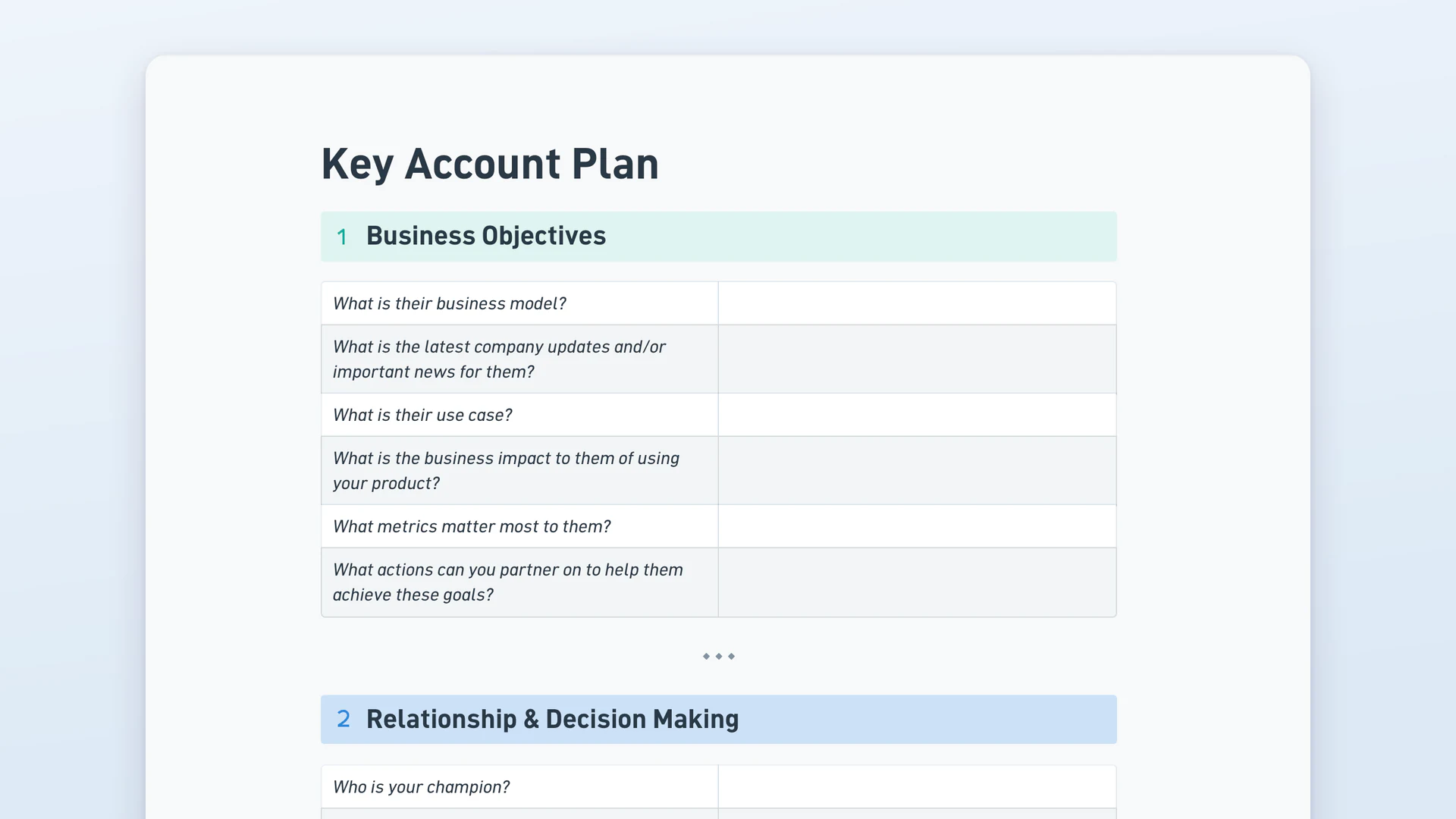
A key account plan is the working document for one high-value customer: what their business is trying to achieve, who decides and who blocks, where the account might churn or grow, and what you'll do about it. This template asks 23 questions across five tables, from business model and metrics through champion and budget holder to actions split across 90 days and a year. Account managers keep one per account.
Most teams use these terms for the same document, and vendors use them interchangeably. Where a distinction is drawn, a key account plan is the operational doc for one named customer: contacts, risks, next actions. A strategic account plan takes a longer view across a small portfolio of accounts, covering how each fits the company's growth and where the whitespace sits. The structure overlaps almost entirely.
A key account plan is a document covering one high-value customer: their business goals, the people who influence decisions, the risks to the relationship, and the actions you'll take to keep and grow it. Companies write one per strategic account rather than one for the whole book, because the point is depth on a single customer.
Five things carry most of the value. The customer's business objectives and the metrics they're measured on. A map of who champions you, who blocks you and who holds the budget. An honest read on churn risk and what's blocking growth. Their feature requests checked against your roadmap. And time-bound actions, ideally split between the next quarter and the next year.
Quarterly works for most teams, with a fuller review before renewal. The 90-day action table is designed for that rhythm. Plans updated only at renewal tend to be written backwards to justify what already happened, which is why churn risks get noticed too late to act on them.
Usually the account manager or customer success manager who owns the relationship, with input from sales on commercial history and from product on what's actually on the roadmap. A sales account plan and a customer success account management plan use the same structure; what changes is whether the actions lean toward expansion or retention.
Revenue is the usual trigger, but it isn't the only one. Accounts get treated as key when losing them would be visible, when they influence others in their market, or when they're a reference customer. The practical test is whether the account justifies a dedicated plan and a named owner rather than being managed alongside fifty others.