Brand
Get all logo versions.
Download 


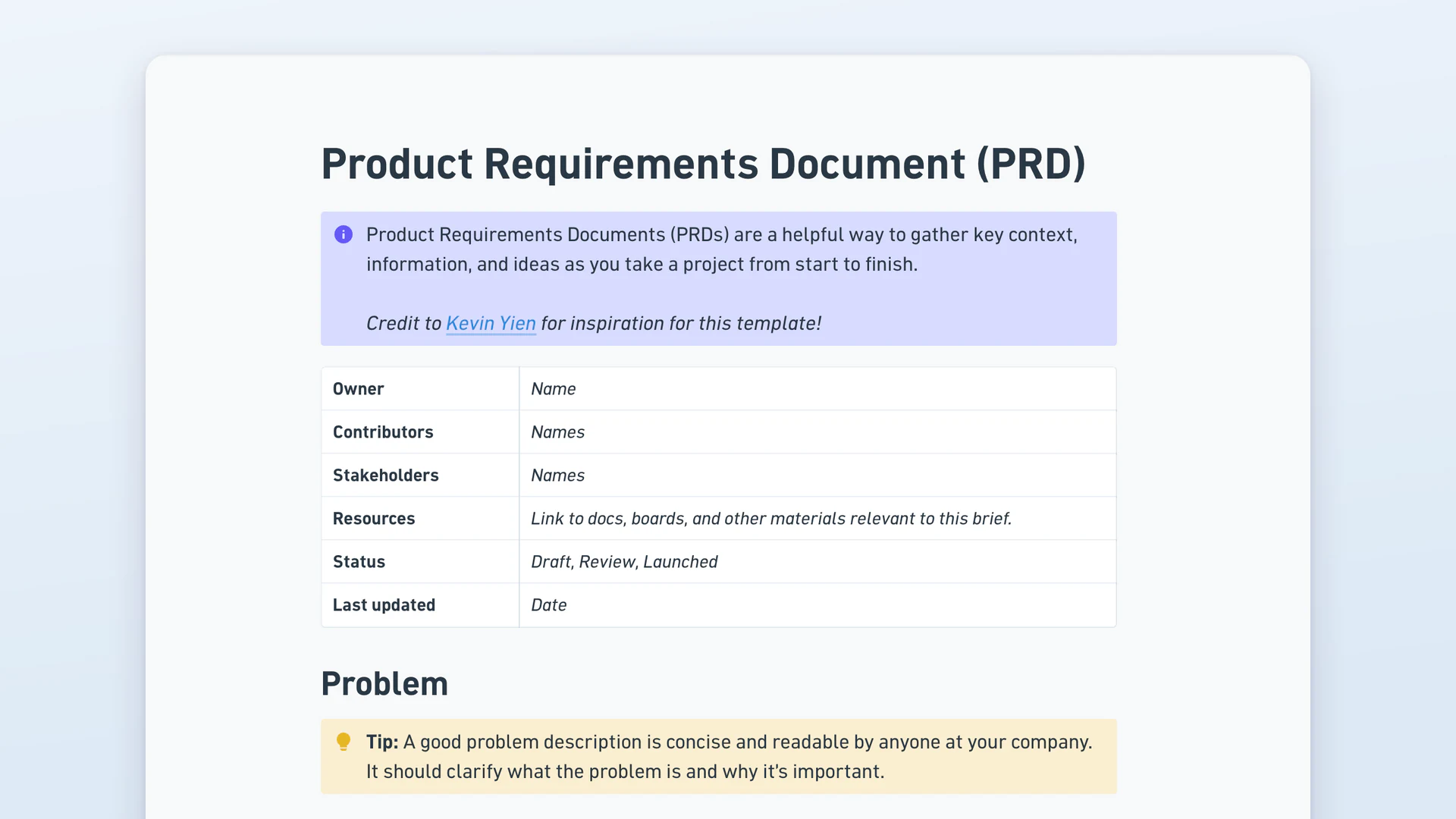
A product requirements document, or PRD, sets out what a team is building and why: the problem, the solution in outline, what's deliberately out of scope, and how it reaches customers. This template opens with an owner and status header, then runs Problem and Impact, Solution Outline with key features, flows and no-gos, a Launch Plan with milestone exit criteria, and a checklist by team. Product managers write one before build starts.
These three sit at different layers. A business requirements document, or BRD, states the business case and the organisational need. A product requirements document translates that into what the product must do: the problem, the features, the flows, the success measures. A product spec, written by engineers or designers, defines how it gets built. BRD is the why, PRD is the what, spec is the how.
A PRD, or product requirements document, is the document that defines what a team is building and why. It covers the problem being solved, the evidence it matters, the outline of the solution, what's explicitly out of scope, and how the work reaches customers. Product managers write it before development starts, so design and engineering are working from the same brief.
A product requirements document keeps a project's scope, reasoning and dependencies in one place. Engineering reads it to know what to build, design reads it for the flows, and teams like analytics and support read it to see what they owe before launch. It also functions as a record: when someone asks why a feature works a certain way, the PRD holds the answer.
Start with the problem and the evidence, not the feature. Then outline the solution as a prioritised feature list, and write the no-gos immediately after so scope has a boundary. Add milestones with exit criteria rather than dates alone. Any sample product requirements document worth copying has a no-gos section, and it's the one most people skip.
This template ships with four. Internal pilot ends when there are no P0 or P1 bugs on a rolling seven-day basis. Beta ends when a set number of customers say they'd be disappointed if you removed the feature. Early access ends once a number of customers convert from competitors. Public launch moves to measure and monitor. Each is checkable, unlike "beta looks good".
Six do most of the work: a header naming the owner and status, the problem with supporting evidence, the impact or success metrics, a solution outline with key features and no-gos, a launch plan with milestones, and an operational checklist covering what other teams need. An appendix for open questions, FAQs and a changelog catches everything that doesn't fit.