Brand
Get all logo versions.
Download 


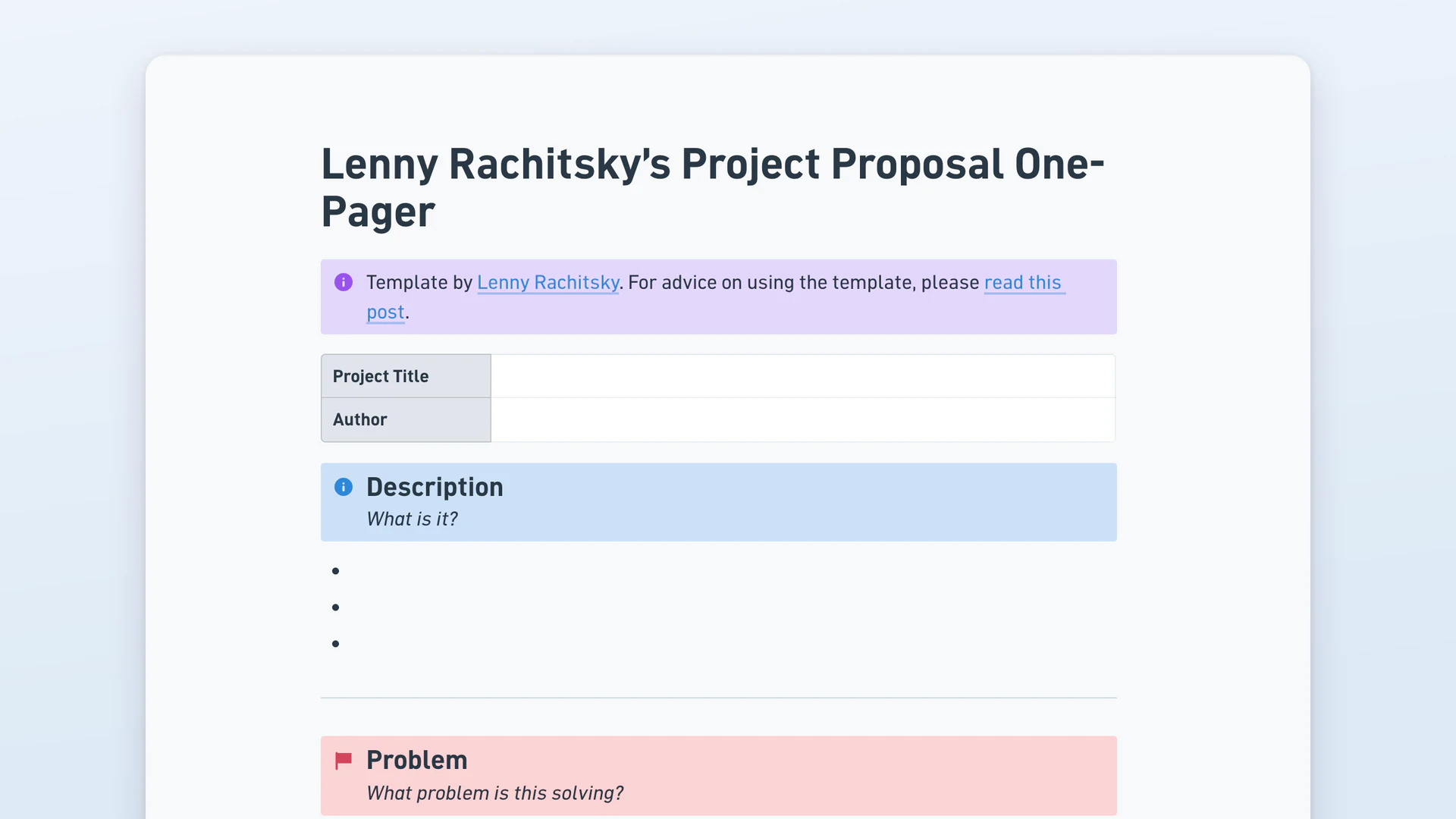
A project one-pager is a single page that earns a decision: what the project is, the problem it solves, who it's for, how you'll test it, when it ships, and how you'll know it worked. This template asks those questions as nine prompted sections, in a framed layout and a sticky-note version. Product and project leads use it to align stakeholders before any detailed planning starts.
A one-pager and a PRD sit at opposite ends of a project's paper trail. The one-pager comes first and argues: here's a problem, evidence it matters, a rough shape, a date, a metric; it's written for the people who say yes. The PRD comes after the yes and specifies: exact behavior, edge cases, requirements, written for the people who build. Skipping the one-pager means writing a PRD for a project nobody agreed to.
A project one-pager is a single-page summary of a proposed project: the problem, the audience, the rough solution, the timeline, and the success criteria. It exists to get stakeholders aligned and a decision made before detailed planning begins. Good ones run 300 to 600 words; if the case can't be made in a page, the scope usually isn't clear yet.
Nine things cover it: a title, a one-line description, the problem, the evidence it's real and worth solving, the audience, roughly what the solution looks like, the experiment or delivery plan, the ship date with milestones, and the success measure. Budget and risks earn a line each when they're decision-relevant. Everything else belongs in the PRD that comes later.
They're close cousins; the difference is audience and length. The one-pager is strictly one page, written for decision-makers, and persuasive: should we do this? A project brief runs one to two pages, written more for the delivery team, and descriptive: here's the scope and requirements we agreed. In many teams the approved one-pager simply grows into the brief.
Before any detailed planning, and ideally before the idea has momentum: the page is cheapest to kill when nothing's been built on top of it. Typical triggers are proposing a new initiative, requesting people or budget, or entering a prioritization round. Amazon's working-backwards press release is the famous variant: same instinct, write the one-pager first and let it argue for the project.
One page, literally: about 300 to 600 words, readable in three minutes. The constraint is the value. Cutting to a page forces you to decide what the project actually is, and an exec who gets a page reads it, while a deck gets skimmed. If a section won't compress, that's a finding: the scope or the problem needs another pass before you ask for a decision.