Brand
Get all logo versions.
Download 


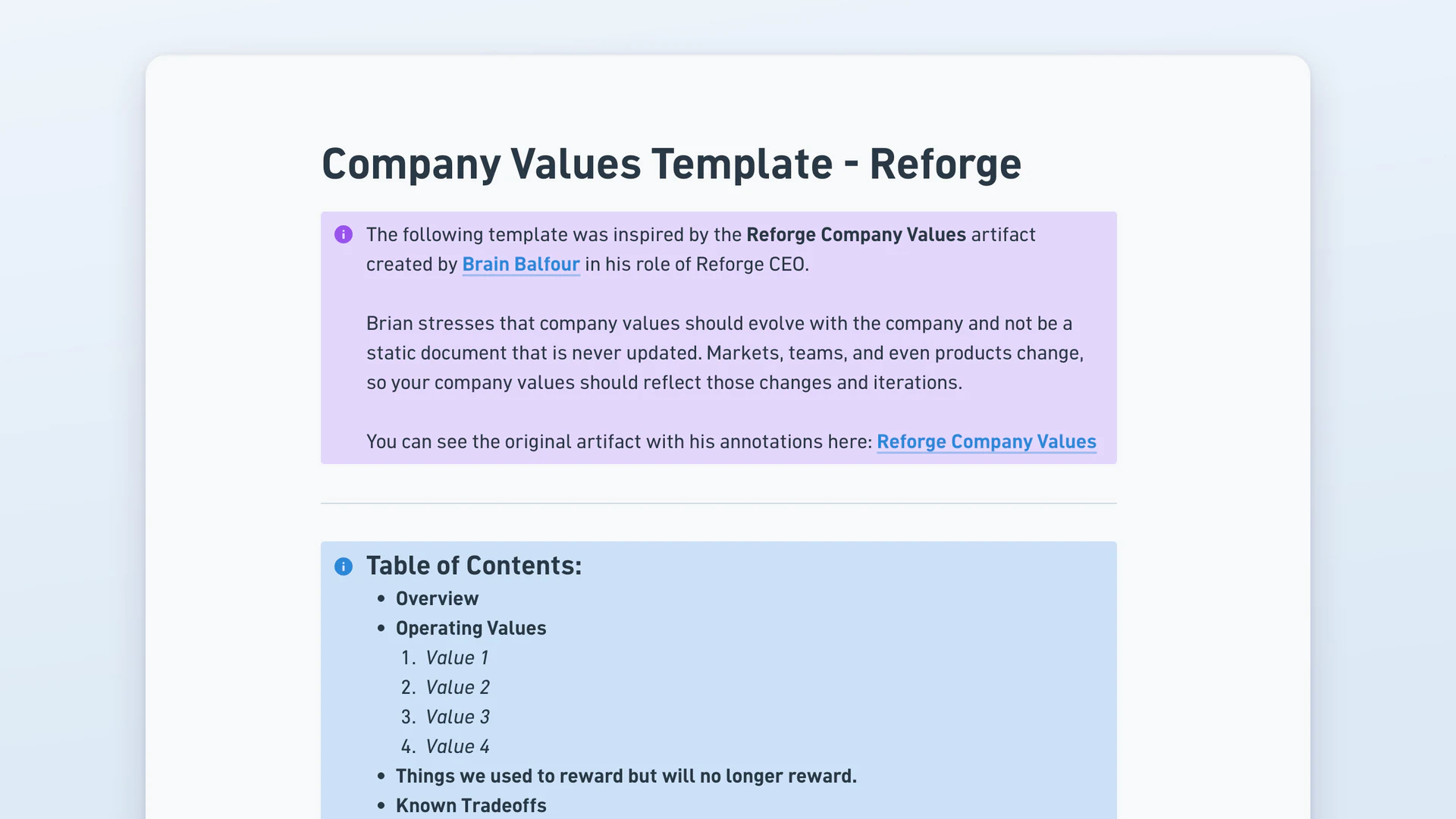
Company values are the principles a company states about how it works: how people make decisions, what behaviour gets rewarded, and what gets refused. This template gives each value three parts, the why, the what, and what it doesn't mean, then closes with the behaviours the company will stop rewarding and the tradeoffs the values create. Leadership teams use it when values are being written or rewritten.
Company values are what an organisation writes down about how it intends to operate. Company culture is how people actually behave when nobody is checking. The two only match when the values are reinforced by what gets rewarded, promoted and refused. That's why a values doc is more convincing when it names what the company will stop rewarding: that line is where the stated values and the real culture are forced to meet.
Company values are the stated principles that guide how a company makes decisions and how its people are expected to behave. The values of a company typically cover what it prioritises when two good options conflict, what behaviour it rewards, and what it refuses to do. Values differ from a mission, which describes what the company is trying to achieve rather than how it operates.
Written the way this template asks, a value called "default to writing" looks like this. The why: decisions made in meetings don't survive the week, written ones do. The what: proposals go in a doc before the discussion, not after. What it doesn't mean: not that you avoid talking to people, and not that every small choice needs a document.
Company values matter when a decision has no obviously right answer and someone has to choose without asking. Values tell that person what the company would prefer. They also set what gets rewarded in reviews and promotions, which is where employees learn what the company actually means, regardless of what the values page says.
Start from behaviour you already see rather than aspirations. To determine company values, ask which decisions your best people made that you'd want repeated, and which ones you regret. Draft more than you need, then cut to about four. For each, write why it exists, what it looks like in practice, and what it doesn't mean.
In practice the terms are used interchangeably, and most companies publish one list under either name. Where people do separate them, core values are the small permanent set that wouldn't change even if the business model did, while company values or operating values are the working principles that get revised as the company grows. This template treats them as operating values, meant to be rewritten.